Two weeks at Google completed

My first two weeks at Google are officially in the books, and “velocity” has taken on a whole new meaning. Between onboarding and deep-diving into infrastructure paradigms, I am incredibly grateful for this complex challenge within Healthcare and Life Sciences (HLS).


Tackling HLS data infrastructure reminds me of splitting logs. If a log has a knot in it, it’s difficult to split.

In the data world, those “knots” are siloed clinical and pharmaceutical legacy systems and strict compliance guardrails. I am thrilled to bring my background in high-scale operational databases and my healthcare and life sciences background to this challenge.

The Power of the Data Foundation

If these two weeks have taught me anything, it’s that an organization’s AI capability is directly bottlenecked by its data foundation. You cannot build transformative, agentic enterprise applications on weak, siloed database systems. Whether managing complex global operational workloads or scaling real-time transactional layers, the underlying infrastructure must deliver reliability and data integrity.

The Shift to Agentic Data Clouds

We are moving past basic, reactive cloud infrastructure toward sophisticated, integrated ecosystems. Modern enterprise strategies are shifting toward “Agentic Data Clouds“—environments where advanced AI agents operate natively alongside transactional data systems to safely monitoring context, anticipate needs, and orchestrate outcomes at scale.

Recent major public announcements:

The Merck Partnership: Merck is committing up to $1 billion over the next decade to establish Google Cloud as its primary AI anchor. This partnership deploys an agentic platform across Merck’s end-to-end R&D, manufacturing, and commercial functions, using Gemini Enterprise to speed up scientific breakthroughs. Learn more via the Official Merck Press Release.

CVS Health & Health100: CVS Health and Google Cloud have launched Health100, an open-ecosystem health technology services platform. By combining robust data interoperability infrastructure with advanced multimodal AI, Health100 securely aggregates patient data across insurers, providers, and pharmacies to offer unprecedented cost transparency and personalized health guidance. Read details in the Official CVS Health Announcement.

​Disclaimer: This post reflects my personal perspectives and reflections as I embark on my journey with Google Cloud, celebrating the industry momentum and technological foundations driving healthcare transformation.

Posted in AI, Data, Google, Healthcare, Uncategorized | Tagged , , , , , , , , | Leave a comment

Strategic Execution: What Splitting Wood Teaches Us About Growth

What does it take to drive results and move a career forward?

Future firewood

Whether you are hitting a sales quota, architecting a data platform, or building a team, the fundamentals don’t change: there is no substitute for execution.


Chopping wood is a great reminder of how to approach professional growth:


Identify the Leverage Points:

Swinging wildly at a log with pure brute force just exhausts you and gets the blade stuck. You have to read the grain, find the natural cracks, and strike with precision. In business, success isn’t just about working longer hours; it’s about strategic alignment and finding the right leverage points to maximize impact. This improves the output you have per hour of your time.


Consistency Builds the Stack:

You don’t get a season’s worth of firewood from a single swing. It’s one log, one repetition at a time. The major milestones—complex project completions, career advancements, mastering new technology—are just the cumulative result of daily, disciplined execution when no one is watching.


Sharpen the Tools:

A dull axe makes a simple job miserable and inefficient. Taking the time to maintain your edge is exactly like investing in technical upskilling, understanding new architectural patterns, or stepping back to evaluate your strategy.


It’s easy to look at a finished, neatly stacked pile—or a polished career milestone—and focus only on the end result. But the actual value, the resilience, and the skill are built right here in the woods, one deliberate swing at a time.


Focus on the fundamentals, keep sharpening your toolset, and execute. This is what can bring you long-term satisfaction.

Posted in Development, Job Performance, Training | Tagged , , , , , | 1 Comment

New Chapter: Joining Google Cloud as a Database Sales Specialist

I announced yesterday, May 18th 2026, here on LinkedIn that I started at Google Cloud as a Database Sales Specialist!

After many years working with customers on cloud, databases, analytics, and AI, I’m excited to continue helping organizations modernize the systems that matter most to their business. Databases sit at the center of so many critical decisions: how companies serve customers, protect data, scale applications, reduce operational risk, and unlock new AI-driven opportunities.

That is what makes this role so exciting.

Google Cloud has a powerful and growing portfolio across transactional databases, analytics, AI, infrastructure, and open source cloud innovation. I’m looking forward to working with customers as they evaluate where platforms like AlloyDB, Spanner, Cloud SQL, Firestore, and Google Cloud’s Database products and AI ecosystem can help them move faster, simplify operations, and build for the future.

I’m also grateful for the colleagues, customers, mentors, and partners who have supported me along the way. Career transitions are always meaningful moments. They give you a chance to reflect on what you’ve learned, where you’ve been, and what kind of impact you want to make next.

For me, that focus remains clear: helping customers solve complex technology and business challenges with cloud, data, and AI.

I’m excited for what comes next at Google Cloud.

Thank you to everyone who reached out, commented, encouraged me, or celebrated the news with me. I truly appreciate it.

Posted in Data, Architecture, SQL Server, Healthcare, Open Source, AI, Google | Tagged , , , , , | Leave a comment

George Walters – Public Speaking

I’ve had the opportunity to deliver a range of public speaking sessions over the years, focused on helping people understand complex technical topics in a practical, approachable, and engaging way.

I’ve always enjoyed making technical content easier to understand, bringing energy to the discussion, and sharing knowledge with the broader community. Many of these sessions have been organized through platforms like Sessionize, which has become a common hub for community-driven events and speaker submissions.

As I look ahead, I’m open to new speaking opportunities across topics such as data platforms, cloud modernization, analytics, AI, and strategic Data & AI transformation.

Thank you to the organizers, communities, and attendees who continue to create spaces for learning, collaboration, and knowledge sharing.

https://sessionize.com/gwalters69/

Posted in AI, Architecture, Azure, Conferences, Data, Fun, Open Source, Training | Tagged , , , , , , | Leave a comment

Grateful for the Journey, Excited for What’s Next

After 19.5 years at Microsoft, I’m closing one incredible chapter and preparing for the next per this LinkedIn Post.

It’s hard to put nearly two decades into a few paragraphs. Microsoft has been a place where I grew up professionally, learned from some of the smartest people in the industry, worked with amazing customers, and had the privilege of being part of major shifts in technology — from SQL Server and business intelligence to Azure, cloud modernization, data platforms, analytics, and AI.

I’ve had the opportunity to work with customers on some of their most important technology decisions: modernizing legacy systems, moving mission-critical workloads to the cloud, building data platforms, improving analytics, and helping organizations think differently about what’s possible with AI. Those conversations have shaped me. They taught me that technology is never just about infrastructure, databases, or platforms. It’s about business outcomes, people, trust, and execution.

I’m deeply grateful to the colleagues, leaders, partners, and customers who have been part of this journey. I’ve learned from so many people along the way, and I’m proud of the relationships built over the years.

While I’m leaving Microsoft, I am not leaving the work that has energized me for most of my career.

My future will continue to be rooted in cloud, databases, data platforms, analytics, and AI. I remain passionate about helping enterprises modernize, simplify, and unlock value from their data. The database and cloud markets are only getting more important as companies rethink their architectures for an AI-driven world. That is where I want to keep contributing.

So this is both a thank you and a new beginning.

Thank you, Microsoft, for nearly two decades of learning, growth, challenge, and opportunity.

And thank you to everyone who has been part of the journey so far. I’m excited for what comes next.

Posted in AI, Azure, Data, Job Performance, SQL Server | Tagged , , , , | 1 Comment

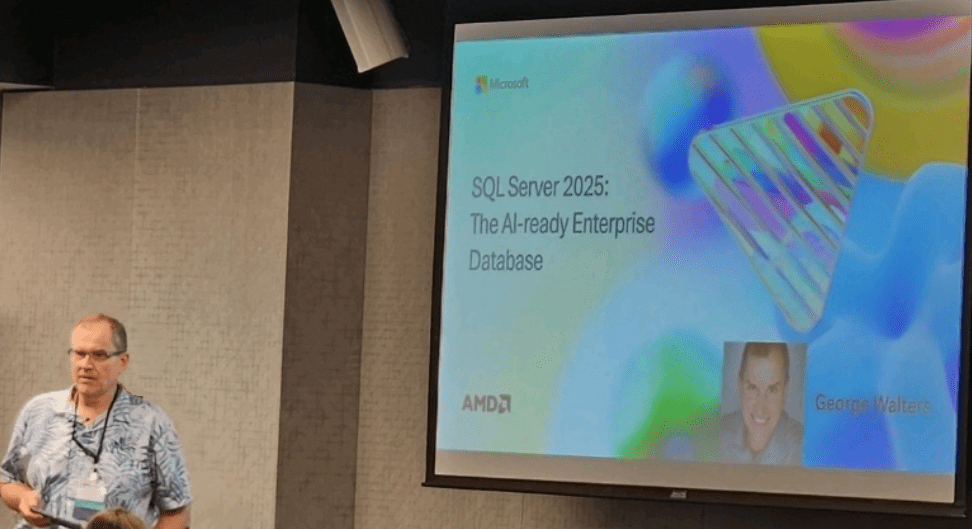
Microsoft SQL Server 2025 is coming! SQL 2025 Features, and Azure Arc features

My shirt is from 2013, when I presented at SQL Saturday Rochester

Thanks to AMD and their EPYC processors for sponsoring and having great features that help you run SQL Server faster!

There is a SQL Server 2025 Blog Series for you to keep up.

Here are the big improvements, now in public preview. Most of this is from Microsoft.com learn documentation. At the end, see how Azure Arc can enhance capabilities for on-premises or other-cloud workloads.

AI & Vector Features

New feature or updateDetails
Copilot in SQL Server Management StudioAsk questions. Get answers from your data.
Vector data typeStore vector data optimized for operations such as similarity search and machine learning applications. Vectors are stored in an optimized binary format but are exposed as JSON arrays for convenience. Each element of the vector can be stored either using a single-precision (4-byte) or half-precision (2-byte) floating-point value.
Vector functionsNew scalar functions perform operations on vectors in binary format, allowing applications to store and manipulate vectors in the SQL Database Engine.
Vector indexCreate and manage approximate vector indexes to quickly and efficiently find similar vectors to a given reference vector.

Query vector indexes from sys.vector_indexes. Requires PREVIEW_FEATURES database scoped configuration.
Manage external AI modelsManage external AI model objects for embedding tasks (creating vector arrays) accessing REST AI inference endpoints.

Developer Enhancements

New feature or updateDetails
Change event streamingCapture and publish incremental DML changes of data (such as updates, inserts, and deletes) in near real-time. Change event streaming sends details of data changes such as the schema, previous values, and new values to Azure Event Hubs in a simple CloudEvent, serialized as either native JSON or Avro Binary. Requires PREVIEW_FEATURES database scoped configuration.
Fuzzy string matchingCheck if two strings are similar, and calculate the difference between two strings.
Regular expressionsDefine a search pattern for text with a sequence of characters. Query SQL Server with regex to find, replace, or validate text data.
Regular expressions functionsMatch complex patterns and manipulate data in SQL Server with regular expressions.
External REST endpoint invocationCall REST/GraphQL endpoints from other Azure services from the SQL Database. With a quick call to the system stored procedure sp_invoke_external_rest_endpoint, you can:

– Have data processed via an Azure Function
– Update a Power BI dashboard
– Call a local, in-house enterprise REST endpoint
– Talk to Azure OpenAI Services
JSON data in SQL ServerUse SQL Server built-in functions and operators to:

– Parse JSON text and read or modify values.
– Transform arrays of JSON objects into table format.
– Run any Transact-SQL query on the converted JSON objects.
– Format the results of Transact-SQL queries in JSON format.
– Review examples at: JSON data type: Store JSON in a native binary format.
Batch mode optimizations for built-in functionsPerformance improvements for the following built-in functions:

– Mathematical functions
– DATETRUNC
New Chinese collationsVersion 160 to support GB18030-2022 standard.

New SQL Developer Editions

SQL Server 2025 Standard Developer edition is a free edition licensed for development. It includes all features of SQL Server Standard edition.

  • Develop new applications for Standard edition.
  • Set up a staging environment to certify the upgrade of an existing application from the Standard edition to SQL Server 2025 Standard edition before deploying it in production.

SQL Server 2025 Enterprise Developer edition includes SQL Server Enterprise edition features.

  • Develop new applications for Enterprise edition.

Functionally equivalent to Developer edition in previous versions.

Analytics

New feature or updateDetails
Connect to ODBC data sources with PolyBase on SQL Server on LinuxSupports ODBC data sources for SQL Server on Linux.
Native support for specific source typesPolyBase services no longer required for parquet, Delta, or CSV.
TDS 8.0 support for PolyBaseWhen you use Features of the Microsoft ODBC Driver for SQL Server on Windows for PolyBase, TDS 8.0 is available for SQL Server as an external data source.
PolyBase support for managed identityUse managed identity to communicate to Microsoft Azure Blob Storage and Microsoft Azure Data Lake Storage.

Availability and Disaster Recovery

New feature or updateDetails
Always On availability groups
Availability group asynchronous page request dispatching improvementPerform asynchronous page requests and in batches during failover recovery. Enabled by default.
Allow database to switch to resolving stateAfter a failure to read the persisted configuration data due to network service interruption.
Configure AG group commit wait in millisecondsSet availability group commit time in milliseconds for an availability group replica so that transactions are sent to the secondary replica faster.
Control communication flow for availability groupsA new sp_configure option lets the primary replica determine if the secondary replica falls behind. With the new configuration option, you can optimize communication between HADR endpoints.
Distributed AG support for a contained AGConfigure a distributed availability group between two contained availability groups.
Distributed AG synchronization improvementsImproves synchronization performance by reducing network saturation when the global primary and forwarder replicas are in asynchronous commit mode.
Fast failover for persistent AG health issuesSet the RestartThreshold for an Always On availability group to 0, which tells the WSFC to fail over the availability group resource immediately when a persistent health issue is detected.
Improved health check timeout diagnosticsImproves synchronization performance by reducing network saturation when the global primary and forwarder replicas are in asynchronous commit mode. This change is enabled by default and doesn’t require any configuration.
REMOVE listener IP addressNew parameter in the ALTER AVAILABILITY GROUP Transact-SQL command lets you remove an IP address from a listener without deleting the listener.
Set NONE for read-only or read-write routingWhen configuring READ_WRITE_ROUTING_URL and READ_ONLY_ROUTING_URL, you can set to NONE to revert specified routing by using the ALTER AVAILABILITY GROUP Transact-SQL command to automatically route traffic back to the primary replica.
Configure TLS 1.3 encryption with TDS 8.0Configure TLS 1.3 encryption for communication between the Windows Server Failover Cluster and an Always On availability group replica with TDS 8.0 support.
Always On failover cluster instance
Configure TLS 1.3 encryption with TDS 8.0Configure TLS 1.3 encryption for communication between the Windows Server Failover Cluster and Always On failover cluster instance (FCI) with TDS 8.0 support.
Backups
Back up to immutable blob storageAvailable when backing up to URL.
Back up on secondary replicasIn addition to copy-only backups, you can now also perform full and differential backups on any secondary replica.
Log shipping
Configure TLS 1.3 encryption with TDS 8.0Configure TLS 1.3 encryption for communication between servers in a log shipping topology.

Intelligent Query Processing: Contains various improvements aimed at optimizing query execution and overall database performance.

Query Store Enhancements: Now includes the capability to block problematic queries using ABORT_QUERY_EXECUTION, helping maintain system stability and performance.

Security

New feature or updateDetails
Security cache improvementsInvalidates caches for only a specific login. When security cache entries are invalidated, only those entries belonging to the affected login are affected. This improvement minimizes the impact of non-cache permissions validation for unaffected login users.
OAEP padding mode support for RSA encryptionSupport for certificates and asymmetric keys, adding security layers to encryption and decryption processes.
PBKDF for password hashes on by defaultUses PBKDF2 for password hashes by default, enhancing password security and helping customers comply with NIST SP 800-63b.
Managed identity with Microsoft Entra authenticationCan use the Arc-enabled server managed identity in outbound connections to communicate with Azure resources, and inbound connections for external users to connect to SQL Server. Requires SQL Server enabled by Azure Arc.
Back up to/restore from URL with managed identityBack up to, or restore from, URL with a managed identity. Requires SQL Server enabled by Azure Arc.
Managed Identity support for Extensible Key Management with Azure Key VaultSupported for EKM with AKV and Managed Hardware Security Modules (HSM). Requires SQL Server enabled by Azure Arc.
Create Microsoft Entra logins and users with nonunique display namesSupport for the T-SQL syntax WITH OBJECT_ID when using the CREATE LOGIN or CREATE USER statement.
Support custom password policy on LinuxEnforce a custom password policy for SQL authentication logins on SQL Server on Linux.
Configure TLS 1.3 encryption with TDS 8.0 supportTLS 1.3 encryption added with TDS 8 for the following features:
– SQL Server Agent
– sqlcmd utility
– bcp utility
– SQL Writer service
– Configure usage and diagnostic data collection for SQL Server (CEIP)
– Data virtualization with PolyBase in SQL Server
– Always On availability groups
– Always On failover cluster instances (FCI)
– Linked servers
– Transactional replication
– Merge replication
– Peer-to-peer
– Snapshot replication
– Log shipping

Review Breaking changes.

Database Engine

New feature or updateDetails
Optimized lockingReduces blocking and lock memory consumption, and avoids lock escalation.
tempdb space resource governanceImproves reliability and avoids outages by preventing runaway workloads from consuming a large amount of space in tempdb. Supports percent-based limits.
Accelerated database recovery in tempdbProvides the benefits of accelerated database recovery for transactions in the tempdb database, such as transactions that use temporary tables.
Persisted statistics for readable secondariesCreates persisted statistics on readable secondaries so that workloads that run against secondary replicas are optimized.
Change tracking improvementsAdaptive shallow cleanup improves change tracking auto cleanup performance.
Columnstore improvementsMultiple improvements in columnstore indexes:
– Ordered nonclustered columnstore indexes
– Online index build and improved sort quality for ordered columnstore indexes
– Improved shrink operations when clustered columnstore indexes are present
Memory-optimized container and filegroup removalSupports removal of memory-optimized containers and filegroups when all In-Memory OLTP objects are deleted.
tmpfs support for tempdb on LinuxEnable and run tempdb on tmpfs for SQL Server on Linux.
ZSTD Backup compression algorithmSQL Server 2025 (17.x) Preview adds a faster and more effective backup compression algorithm – ZSTD.
Optimized sp_executesqlEffectively reduce the impact of compilation storms. A compilation storm is a situation where a large number of queries is being compiled simultaneously, leading to performance issues and resource contention. Enable this feature to allow invocations of sp_executesql to behave like objects such as stored procedures and triggers from a compilation perspective.

Allowing batches which use sp_executesql to serialize the compilation process reduces the impact of compilation storms.
Time-bound extended event sessionsAutomatically stops an extended events session after a time limit elapses. This helps avoid situations where sessions might be left running indefinitely by mistake, consuming resources and potentially generating a large amount of data.
PREVIEW_FEATURESDatabase scoped configuration allows you to enable features that are scheduled for general availability after this version of SQL Server releases for general availability. Review these features in release notes.

Query Store and intelligent query processing

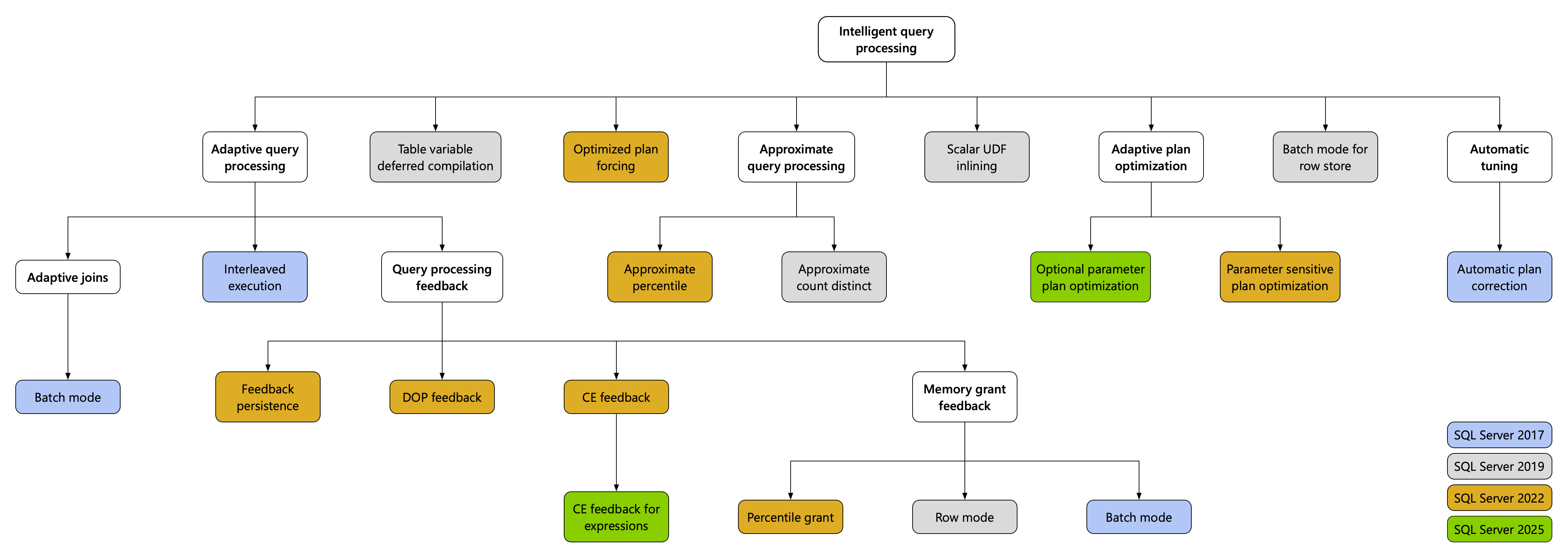
The intelligent query processing (IQP) feature family includes features that improve the performance of existing workloads with minimal implementation effort.

Screenshot of Chart representing the features in the intelligent query processing family.
New feature or updateDetails
Cardinality estimation feedback for expressionsLearns from previous executions of expressions across queries. Finds appropriate cardinality estimation (CE) model choices and applies to future executions of those expressions.
Optional parameter plan optimization (OPPO)Leverages the adaptive plan optimization (Multiplan) infrastructure that was introduced with the Parameter Sensitive Plan Optimization (PSPO) improvement, which generates multiple plans from a single statement. This allows the feature to make different assumptions depending on the parameter values used in the query.
Degree of parallelism (DOP) feedbackNow on by default.
Query Store for readable secondariesNow on by default.
ABORT_QUERY_EXECUTION query hintBlocks future execution of known problematic queries, for example nonessential queries affecting application workloads.

T-SQL Language

Lots of new language related to the AI features, JSON, etc.

Linux

Microsoft Fabric Integration: Offers a unified analytics platform that integrates various data and analytics services to streamline operations.

New feature or updateDetails
Mirroring in FabricContinuously replicate data to Microsoft Fabric from SQL Server 2025 on-premises. Microsoft Fabric already includes mirroring from a variety of sources, including Azure SQL Database and Azure SQL Managed Instance. For more information on SQL Server 2025 database mirroring to Fabric, see Mirrored SQL Server databases in Microsoft Fabric.

Starting in SQL Server 2025 (17.x) Preview, on-premises reporting services is consolidated under Power BI Report Server. For more information, see Reporting Services consolidation FAQ.

Discontinued Features

Data Quality Services (DQS) is discontinued in this version of SQL Server. We continue to support DQS in SQL Server 2022 (16.x) and earlier versions.

Master Data Services (MDS) is discontinued in this version of SQL Server. We continue to support MDS in SQL Server 2022 (16.x) and earlier versions.

Synapse Link is discontinued in this version of SQL Server. Use Mirroring in Fabric instead. For more information, see Mirroring in Fabric – What’s new.

Breaking Changes

SQL Server 2025 (17.x) Preview introduces breaking changes to a few SQL Server Database Engine features, such as linked servers, replication, log shipping, and PolyBase.

For more information, see Breaking changes in SQL Server 2025 Preview.

Learn more

Microsoft has Azure Arc to enhance your on-prem or other-cloud capabilities with some Azure features:

Azure Arc for SQL Server 2025 – Key Benefits

FeatureDescription
Centralized ManagementManage all SQL instances (on-prem, edge, multi-cloud) from the Azure portal.
Inventory & InsightsUnified view of versions, editions, and compliance across environments.
Security & GovernanceEntra ID integration for MFA/SSO, apply Azure Policy for consistent security. Extended security updates delivery.
Operational EfficiencyAutomated backups, patching, and best-practice assessments.
Hybrid FlexibilityPay-as-you-go licensing for SQL components (DB Engine, SSAS, SSRS, PBIRS) and centralized view of Licenses
Migration AccelerationContinuous assessments, real-time replication, and Copilot-assisted provisioning.
Azure IntegrationUse Azure Monitor, Defender for Cloud, and other services without moving data.
Learn moreSQL Server enabled by Azure Arc
Azure Arc overview

As always, we have lots of learning resources available to help you!

Posted in AI, Azure, Licensing, Security, SQL Server | Tagged , , , , , , , , , , | Leave a comment

Agentic AI Report — Summer 2025 Update

I had the pleasure of speaking at the nference 2nd agentic AI summit. I am holding the mic 3rd from the left in the above photo. Thank you for that opportunity!

This got me thinking about how to share the way agentic AI leaps from theoretical constructs to enterprise-grade infrastructure. Microsoft has accelerated agent deployment across its ecosystem—building multi-agent systems, domain-specific Copilots (or assistants), and agentic web experiences. Agents are of course front and center across OpenAI, Google, and AWS as well.

In pharma, the strategic calculus involves dramatically faster research cycles. Operations become more efficient if governance, validation, and safety are baked in from the start.

1) Microsoft doubles down on agentic AI leadership

At Build 2025, Microsoft declared the dawn of the “agentic web.” They introduced over 50 new tools. These tools span GitHub, Windows, Azure, and Microsoft 365. They are primed for autonomous collaboration and persistent memory. This includes the GitHub Copilot coding agent and low‑code “Copilot Tuning” for domain‑specific workflows.
(The Official Microsoft Blog, VentureBeat)

2) Multi-agent orchestration gets real

Microsoft unveiled multi-agent orchestration via Copilot Studio, letting agents delegate, collaborate, and co-execute tasks. Complementing this is support for the open Agent2Agent (A2A) protocol—enabling seamless, secure agent communication across clouds and systems.
(Cloud Wars)

3) Platform infrastructure strengthens—MCP, Foundry, Dataverse, and identity

The Model Context Protocol (MCP) is now integral to Copilot Studio and Azure AI Foundry, enabling agents to access enterprise data and services. Microsoft also added Entra Agent ID for governance and traceability, while Dataverse becomes a deep agent data platform.
(Constellation Research Inc.)

4) Agent Factory & Agent Factory series

Microsoft appointed a “CoreAI” leadership team to transform Microsoft into an AI agent factory—a platform where businesses can build autonomous agents using GitHub, Copilot, and Azure. The “Agent Factory” blog series (part 2 published recently) offers design patterns and guidance for building production-grade agents.
(The Verge)

5) Agents in everyday productivity and on the Edge

Microsoft is embedding domain‑specific agents directly into the Microsoft 365 Copilot app. These include Researcher, Analyst, Facilitator, Interpreter, Project Manager, and Employee Self‑Service agents. They are live or in preview within Microsoft 365 Copilot.  I personally find immense value in Researcher (Think, a grad-level assistant), and Analyst (Someone really good at numbers)
(Microsoft Adoption)

Elsewhere, the Edge browser hosts an experimental Copilot Mode, enabling context‑aware browsing and task execution across tabs via natural language.
(Windows Central)

6) Vision of human agent-bosses & personal AI companions

Microsoft envisions a future where every worker becomes an “agent boss.” These workers will manage AI employees that automate tasks with human oversight. This approach facilitates increases in agility and productivity. Simultaneously, Microsoft’s AI head outlined a vision for personal AI companions—remembering interactions, offering visual memory, and driving user-level personalization.
(The Guardian)

7) Pharma adoption accelerates

Viz.ai — Agentic AI — Healthcare Isn’t Waiting. Pharma Can’t Either

This June 18, 2025 article discusses agentic AI systems. These intelligent, proactive assistants are already changing clinical care. Pharmaceutical companies should pay attention. A key quote from a Microsoft Life Sciences expert underscores the growing role of Microsoft in this space:

“HCPs need real-time access to therapeutic information, which is often lacking. AI can bridge this gap by ensuring the right treatment reaches the right patient at the right time.”
 Eunice Youhanna, AI Healthcare & Life Sciences Advisory, Microsoft (viz.ai)

The article frames emerging opportunities for pharma around three categories of AI agents:

  1. Clinical AI Agents — embedding therapies into the moment of care decisions.
  2. Analytics AI Agents — generating real‑time insights into clinical behaviors and patterns.
  3. Activation AI Agents — offering a new engagement pathway to support HCPs with timely education or messaging at the point of care. (viz.ai)

Genentech is using Bedrock AgentCore with Claude 3.5 to automate literature reviews. It is also used for internal data synthesis for biomarker/R&D workflows. This cuts weeks of work into minutes while keeping scientist oversight. IQVIA, in partnership with NVIDIA, is deploying agentic orchestration for clinical and commercialization systems. Regulatory bodies see AI as a “new normal” at meetings like DIA 2025. AstraZeneca is exploring AI‑powered clinical data querying via Bedrock.

Sources:

Posted in AI, Data, Healthcare | Tagged , , , , | Leave a comment

SQL Saturday NYC 2025 Conference, a Success!

Once again, the organizers and volunteers of SQL Saturday NYC created a wonderful experience at the Microsoft Times Square office!

I had the privilege and pleasure of delivering two sessions. One session was on the private preview of SQL Server 2025. My second session covered two areas: MySQL, PostgreSQL, Oracle, and other DBMS choices on Azure, as well as Microsoft Fabric.

The excellence of who organizes and volunteers to speak at SQL Saturdays shines in delivering excellence to the attendees. You can do this too! There is great help from various folks to build these community events.

This year was the first year for a student track! Newcomers welcomed this, and I saw them exclaim how great it was for them.

Later this fall in the northeast, the New England SQL User group will have SQL Saturday Boston in late September. Keep track here or on my Linkedin for announcements.

I love these events, and hope you join the community close to where you live! SQL Saturdays are worldwide!

Looking for demos or more information?

Microsoft Fabric’s YouTube channel is here: https://www.youtube.com/@MicrosoftFabric

For MySQL in Azure,https://www.youtube.com/@MicrosoftDeveloper/search?query=mysql

For PostgreSQL in Azure, https://www.youtube.com/@MicrosoftDeveloper/search?query=postgresql

For Oracle Database in Azure, https://www.youtube.com/watch?v=PnRwvZEPw7s

Posted in AI, Architecture, Azure, Business Intelligence, Conferences, Data, Fun, Open Source, SQL Server, Training, Uncategorized | Tagged , , , | Leave a comment

Key Highlights from Fabric Community Conference 2025

Fabric Community Conference 2025 just finished this past week. There have been a lot of updates since last year when I published this blog: https://george-walters.com/2024/05/10/microsoft-fabric-presentation-and-links-to-help-you/

Please review that blog for the basics around Microsoft Fabric, and how to migrate towards it from Power BI Premium.

This is the official Microsoft Fabric blog showcasing new features: https://www.microsoft.com/en-us/microsoft-fabric/blog/2025/03/31/fabcon-2025-fueling-tomorrows-ai-with-new-agentic-capabilities-and-security-innovations-in-fabric/

One new overarching collection of blogs is by Worldwide Fabric lead Marc Reguera: https://www.linkedin.com/pulse/all-published-blogs-from-fabcon-marc-reguera-raxec/?trackingId=5x7sLKe5%2Bl5fr2JmbIv%2B6Q%3D%3D

Check the Fabric blog frequently for new updates!

Here are some features to notice:

Shortcuts for OneLake

Shortcuts are objects in OneLake that point to other storage locations. The location can be internal or external to OneLake. 

What is new in Shortcuts?

  • Microsoft Fabric shortcuts enable organizations to unify their data. These shortcuts provide integration across various domains and clouds. They achieve this by creating a single virtual data lake.
  • Integration with Azure Key Vault allows secure storage and management of secrets, keys, and certificates for connecting to data sources.
  • OneLake shortcuts support the discovery of Delta and Iceberg tables, simplifying table access and metadata recognition.
  • OneLake shortcuts now support connections to Fabric SQL databases, enhancing data integration.
  • OneLake shortcuts support batch creation through REST APIs, streamlining data connection setup.
  • OneLake shortcuts now support CI/CD workflows, enabling seamless management and deployment of shortcuts across different environments.

Database Mirroring into Onelake

Mirroring in Fabric is a form of CDC to copy data into OneLake tables.

What is new with Mirroring?

Here are the key points from the Microsoft Fabric Community Conference page:

  • Mirroring in Fabric: Enables seamless data replication from any database or data warehouse into OneLake, keeping data up to date in near real-time.
  • Firewall Support: Database Mirroring now supports sources behind a firewall, including Azure SQL Database and Snowflake.
  • PostgreSQL Flexible Server: Mirroring now supports Azure Database for PostgreSQL Flexible Server, allowing continuous replication to OneLake.
  • CI/CD Integration: Mirroring supports CI/CD workflows, enhancing development efficiency and reliability.
  • Workspace Monitoring: Mirroring supports detailed logs and performance metrics for comprehensive monitoring.
  • Schema Replication: Mirroring preserves source database schema hierarchy in the mirrored database.
  • Delta Column Mapping: Supports special characters in table column names for seamless replication.

SQL Database in Fabric

You can spin up a SQL Database inside Fabric!

SQL database in Microsoft Fabric is a developer-friendly transactional database. It is based on Azure SQL Database. A SQL database in Fabric uses the same SQL Database Engine as Azure SQL Database. It is a preview feature and currently has a 4TB size limit.

SQL Database in Fabric also gets a Copilot assistant!

What data store should I use?

Here is a decision guide for whether to store data in the Lakehouse, Warehouse, Eventhouse, SQL Database, or Power BI Data Mart.

Security

Microsoft Fabric is a SaaS platform, like many other Microsoft services such as Azure, Microsoft Office, OneDrive, and Dynamics. All these Microsoft SaaS services including Fabric, use Microsoft Entra ID as their cloud-based identity provider. Microsoft Entra ID helps users connect to these services quickly and easily from any device and any network.

Call to Action:

Enable a trial of Microsoft Fabric, or start by provisioning a F-sku in your Azure subscription.

Posted in AI, Architecture, Azure, Business Intelligence, Data, SQL Server | Tagged , , , , , , , , | Leave a comment

Streamline Compliance with Microsoft Purview Solutions

Microsoft Purview is a suite of solutions that can help your organization govern, protect, and manage data, wherever it lives.

Microsoft Purview provides an integrated solution. It helps tackle the fragmentation of data across organizations. Visibility improves with data protection and governance. It also addresses the blurring of traditional IT management roles.

The three main pillars for Microsoft Purview are Data Governance, Data Security, and Risk and Compliance.

Companies adopt Microsoft Purview for several key reasons:

  • Data Discovery & Classification – Identifies and labels sensitive data across various platforms.
  • Regulatory Compliance – Ensures adherence to regulations like GDPR and HIPAA.
  • Data Loss Prevention (DLP) – Provides alerts for potential data leaks.
  • Insider Risk Management – Detects suspicious employee activities.
  • Unified Data Governance – Centralizes data management across environments.
  • Access & Identity Controls – Limits access to authorized users only.
  • Automated Compliance Reporting – Simplifies report preparation for audits.
  • AI-Powered Insights – Enhances data security and risk management with AI.

Here is a nice video introducing Microsoft Purview.

Doesn’t M365 E5 give me security and governance?

Microsoft 365 E5 is the most advanced productivity & security suite, offering top-tier compliance, security, and analytics tools. Microsoft Purview enhances M365 E5. It provides robust data governance, compliance, and risk management across emails, SharePoint, and Teams. It also benefits other M365 services.

What about Governance with Databricks and Unity Catalog?

It’s important to note that Databricks Unity Catalog is superb at inside-of-databricks data governance and security.

Microsoft Purview integrates with Databricks Unity Catalog to provide centralized data governance, security, and compliance across cloud and data environments.

What about Governance with Microsoft Fabric?

By integrating Microsoft Purview with Microsoft Fabric, organizations can:

  • Ensure full visibility over data in OneLake, Power BI, and beyond.
  • Strengthen security & compliance with automated governance controls.
  • Enable trusted, high-quality data for AI and analytics workloads.

What is the difference between Azure Purview and Microsoft Purview?

Azure Purview and Microsoft Purview are related but distinct in their scope and branding:

Microsoft Purview – In 2022, Azure Purview was rebranded as Microsoft Purview. This change reflects its expanded capabilities beyond just Azure. It also highlights its integration with broader Microsoft security and compliance tools.

Microsoft Purview now combines Azure Purview’s data governance with Microsoft’s compliance solutions. It also integrates risk management tools such as Information Protection, Insider Risk Management, and Data Loss Prevention.

How do I get started?

Azure Purview – This was the original name of Microsoft’s cloud-based data governance solution. It focused on data discovery, classification, lineage tracking, and compliance. These features spanned on-premises, multi-cloud, and SaaS environments.

If you’re not an M365 E5 customer, use the 90-day Microsoft Purview solutions trial. This trial allows you to explore additional Purview capabilities. It can help your organization manage data security and compliance needs. Start now at the Microsoft Purview trials hub. Learn details about signing up and trial terms.

Posted in Uncategorized | Tagged , , , , , , , | Leave a comment